Borders Not Closed, Tunji-Ojo Faults Atiku’s Reopening Plan
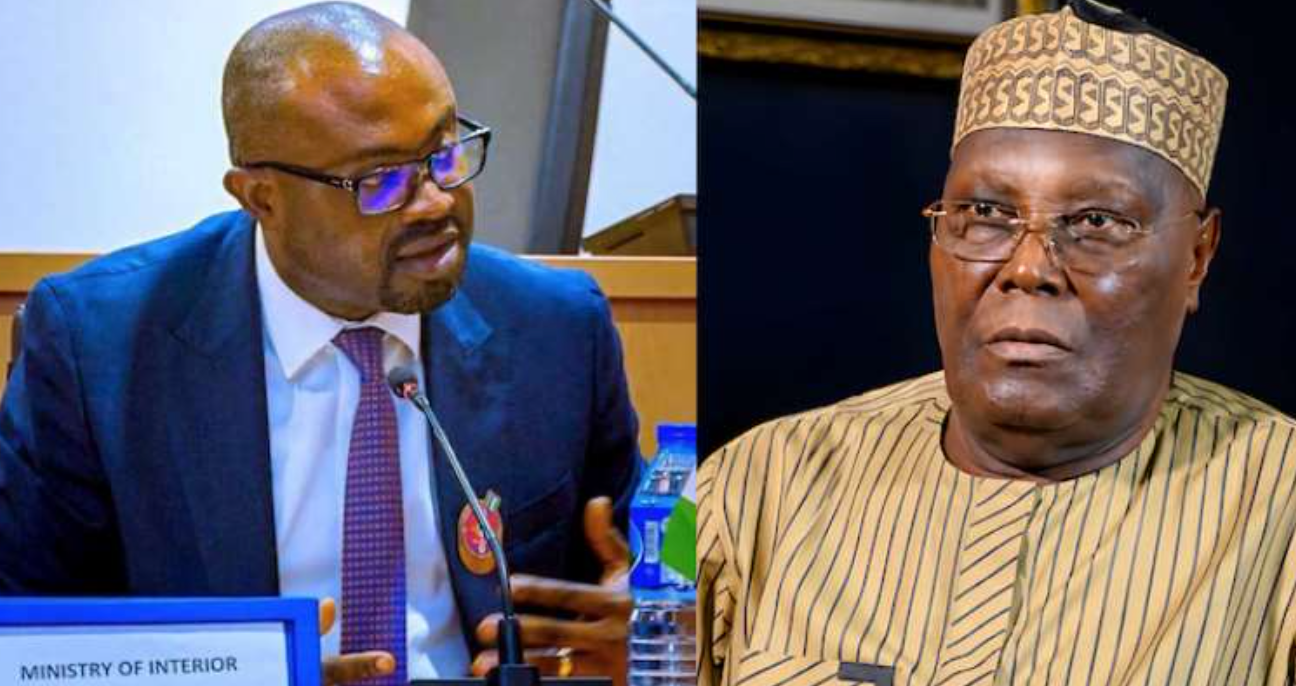
Minister of Interior Olubunmi Tunji-Ojo has faulted former Vice President Atiku Abubakar’s plan to
reopen Nigeria’s land borders if elected president in 2027, stating that the country’s borders are not
closed and therefore cannot be reopened.
Tunji-Ojo issued the clarification in a statement on Saturday in response to Atiku’s comments. The
African Democratic Congress (ADC) presidential candidate had pledged to reopen the land borders,
arguing that prolonged closures had disrupted legitimate trans-border trade and pushed many young
entrepreneurs into bankruptcy and unemployment.
“As the Minister of Interior who supervises the Nigeria Immigration Service, an agency of government in
charge of border and migration management, it is expedient to state that Nigerian borders are not
closed and so cannot be reopened,” Tunji-Ojo said.
He outlined a series of reopenings under successive administrations. On December 16, 2020, the
previous government reopened the Seme, Illela, Maigatari and Mfum borders. Idiroko and Ikom were
reopened for goods and services on April 20, 2022.
Under the current administration, the Kamba and Tsamiya border posts in Kebbi State were reopened in
February 2026, providing links to Niger Republic and Benin Republic respectively.
Tunji-Ojo also disputed Atiku’s references to borders with Cameroon, Chad, Niger and Benin Republic.
He explained that the prolonged closures at Banki and Amchidé on the Cameroon border were driven by
security concerns stemming from Boko Haram activity dating back to 2014, not the 2019 trade policy.
Those crossings were later reopened, with Fotokol and Gambaru following in 2021 after joint military
and stabilisation efforts by Nigeria, Cameroon, Niger and Chad.
The minister acknowledged that not every northern crossing is fully unrestricted, noting that areas
affected by banditry or residual insurgent activity remain under tighter controls as a deliberate security
measure.
He argued that reopening such points prematurely would expose traders and border communities to
greater risk.
Tunji-Ojo challenged Atiku to provide specific details on how his proposed policy would differ from
existing measures rather than presenting border security, trade and infrastructure issues as a single
problem.
By Oyinkansola Shittu.